

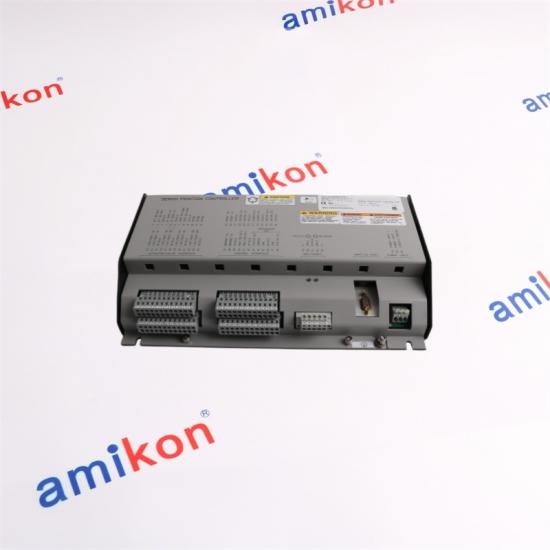
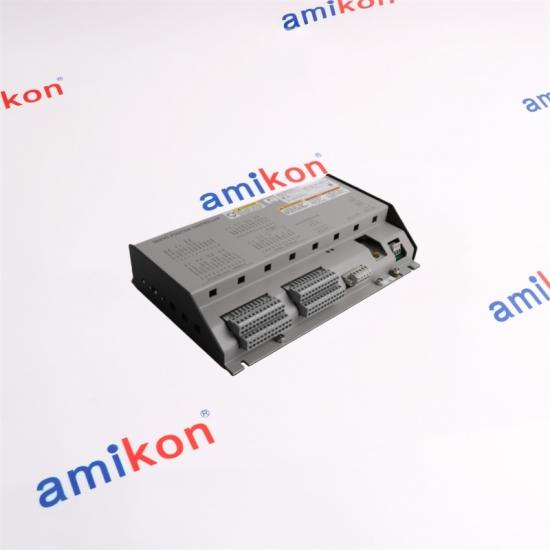
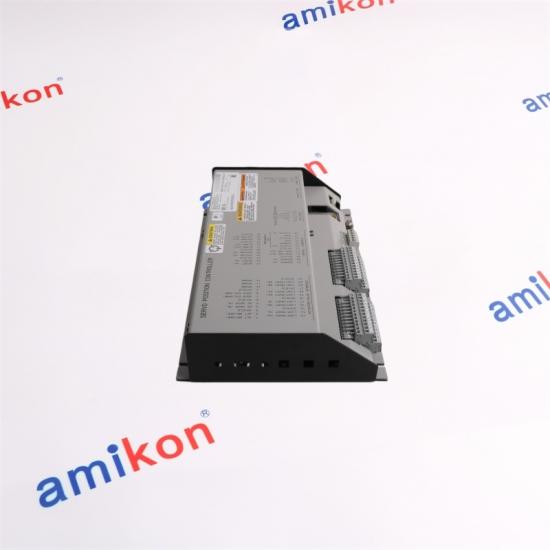
|
Manufacturer |
Woodward |
|
Model |
8200-226 |
|
Descripution |
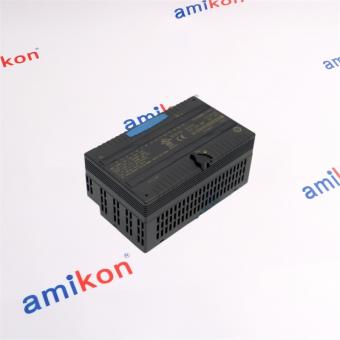
Servo Position Controller |
|
Input Power |
24 V (dc) / (18 to 32) V (dc) |
|
Voltage Range |
18 to 32 V (dc) |
Woodward ➟ USA ➟ 8200-226
Servo Position Controller
CONDITION NEW ➟ IN STOCK
|
|
|
|
Sales manager: Miya zheng ➪ Email:sales@amikon.cn ➪ WhatsApp:86-18020776792
SPC Servo Position Controller


Applications
The Servo Position Controller (SPC) is a servo valve driver that accepts a CANOpenTM * , DeviceNet™ ** or 4-20 mA input position demand signal from a system controller, and accurately positions proportional or integrating servo-valves. The SPC has the required accuracy, responsiveness, and redundancy required for steam or gas turbine hydraulic fuel valve control. For valve position sensing, the SPC accepts feedback signals from one or two (redundant) ac devices or one dc device.
A Windows based service tool is used to configure the SPC, adjust tunables, and monitor parameters via a personal computer. For ease of service, SPC configurations can be done either while connected or disconnected to the unit. Once a configuration has been created, this program allows configurations to be uploaded and downloaded to other SPCs as desired.
The SPC’s position feedback circuit includes integral excitation and signal conditioning circuitry for LVDT and RVDT based position sensing devices.
Description
The SPC is a field programmable servo-driver that controls one integrating or proportional servo-valve, and accepts single or dual feedback signals for valve position sensing.
This compact digital driver is available for either CANOpen or DeviceNet control. Both versions can also use 4-20 mA analog as a primary or backup control signal.
The SPC’s associated PC service tool program allows a user to configure, autocalibrate, dynamically adjust, and manually stroke the controlled servo. Autocalibration routines make servo setup easy and greatly reduce installation times.
The SPC driver is classified for heavy industrial environments, and can be easily bulkhead mounted in IP20 locations.
Driver Specifications
Analog Position Input Demand:
Current Input: 4-20mA (200-ohm input impedance)
Input Power:
24 V (dc) / (18 to 32) V (dc)
Actuator Drive Output (Configurable Options):
Bipolar Output with adjustable null current and the following configurable ranges: ±250 mA, ±100 mA, ±50 mA, ±25 mA, ±10 mA
Unipolar Output Current with the following configurable ranges: (0 to 250) mA, (0 to 100) mA, (0 to 50) mA, (0 to 25) mA
Dither: Adjustable current amplitude at a frequency of 25 Hz, and a duty cycle of 25 %
Position Loop Accuracy:
CANOpen or DeviceNet: ±0.25 % of full scale at 25 °C, temperature sensitivity of less than ±150 ppm/°C Analog (4 to 20) mA: ±0.25 % of full scale at 25 °C, temperature sensitivity of less than ±300 ppm/°C
Position Sensing (2 Channels):
Voltage Feedback: Accepts 3, 4, 5, or 6 wire LVDTs or RVDTs (single excitation driver), (0 to 12) V (dc), (12 to 0) V (dc)
Current Feedback: Accepts (4 to 20) mA, (20 to 4) mA position transducer feedback signals
Relay Driver Outputs (Alarm & Shutdown):
Isolated FETs designed for direct control connection with or without interposing relays
Voltage Range: (18 to 32) V (dc)
Max Current: 500 mA, (10 μA leakage)
Environmental:
Operating Temperature Range: (–40 to +70) °C
Shock: US MIL-STD-810C method 516.2, procedure 1 (30 Gs, 11 ms half sine pulse)
Vibration: Lloyd's Register Test Specification No.1, 1996, Vibration Test 1 (5 Hz to 13 Hz, ±1 mm, 13.2 Hz to 100 Hz, ±0.7 g)
Humidity: Lloyd's Register Test Specification No.1, 1996, Humidity Test (48 Hr Cyclic – Condensing)
Size: (330 x 203 x 76) mm) / (13 x 8 x 3) inches
Mounting: Bulkhead mounted
Ingress Protection: IP20
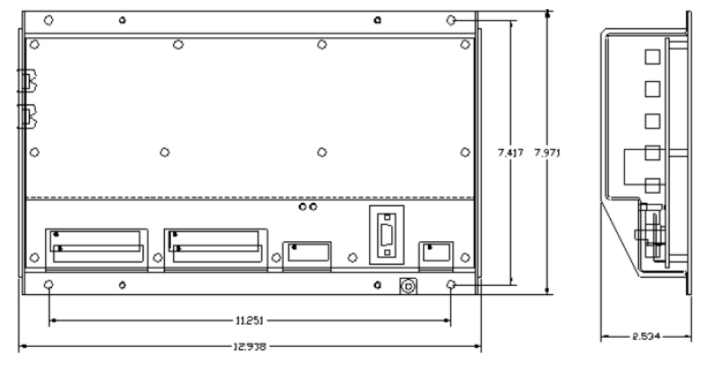
SPC Outline Drawing (Don not use for construction)
FAQ
Q1. How does the WOODWARD 8200-226 Servo Position Controller achieve high-precision actuator positioning in demanding industrial control environments?
A: The WOODWARD 8200-226 Servo Position Controller delivers accurate closed-loop servo positioning by continuously monitoring feedback signals and adjusting actuator movement in real time. This architecture enhances positioning accuracy, minimizes steady-state error, and improves dynamic response for turbine and engine control applications.
Q2. Why is the WOODWARD 8200-226 Servo Position Controller considered suitable for mission-critical governor and turbine automation systems?
A: The WOODWARD 8200-226 Servo Position Controller is engineered for high-reliability industrial environments, offering deterministic servo control, stable feedback regulation, and robust operation under continuous-duty conditions. These characteristics make it well suited for gas turbines, steam turbines, diesel engines, and compressor control systems.
Q3. What key operational advantages does the WOODWARD 8200-226 Servo Position Controller provide when integrated with electro-hydraulic servo mechanisms?
A: When paired with electro-hydraulic actuators, the WOODWARD 8200-226 Servo Position Controller provides rapid response, smooth position modulation, and excellent control stability. Its closed-loop control capability helps reduce overshoot while maintaining precise valve or fuel rack positioning during dynamic load changes.
Q4. Which installation and electrical considerations should engineers evaluate before commissioning the WOODWARD 8200-226 Servo Position Controller?
A: Before installing the WOODWARD 8200-226 Servo Position Controller, engineers should verify compatible input power, actuator interface specifications, signal integrity, grounding practices, and environmental operating conditions. Proper wiring and calibration are essential to ensure optimal servo performance and long-term operational reliability.
Q5. How does the WOODWARD 8200-226 Servo Position Controller contribute to enhanced control system reliability and lifecycle performance?
A: The WOODWARD 8200-226 Servo Position Controller improves overall system dependability through precise servo regulation, stable feedback processing, and durable industrial construction. By maintaining consistent actuator positioning and reducing mechanical stress caused by oscillation or instability, it helps extend equipment service life while supporting reliable long-term operation.
Recommended
|
9907-028 |
5462-948 |
5501-467 |
|
5438-667 |
5462-408 |
9905-969 |
|
5464-643 |
5500-577 |
9905-971 |
|
5464-648 |
5462-916 |
5501-376 |
|
5464-653 |
5462-758B |
9905-968 |
|
5464-850 |
5461-650 |
8516-085 |
|
5466-026 |
5462-744 |
9905-021 |
|
5466-352 |
9907-164 |
8440-1934 |

Amikon - We serve all walks of life in worldwide, help to provide and support their business processes, and adapt to the specific needs of each industry. PLC : Allen Bradley Rockwell, GE FANUC, Schneider Modicon Quantum DCS : ABB, Siemens MOORE, Foxboro, Westinghouse, YOKOGAWA ESD : Triconex, HIMA, Bently Nevada, ICS Triplex Excitation Cards : ABB, GE Marke Sales manager : Jessica | Email : sales3@amikon.cn Mobile : 86-18030235311 | Skype : jessica01235483

Amikon - We serve all walks of life in worldwide, help to provide and support their business processes, and adapt to the specific needs of each industry. PLC : Allen Bradley Rockwell, GE FANUC, Schneider Modicon Quantum DCS : ABB, Siemens MOORE, Foxboro, Westinghouse, YOKOGAWA ESD : Triconex, HIMA, Bently Nevada, ICS Triplex Excitation Cards : ABB, GE Marke Sales manager : Jessica | Email : sales3@amikon.cn Mobile : 86-18030235311 | Skype : jessica01235483

Amikon - We serve all walks of life in worldwide, help to provide and support their business processes, and adapt to the specific needs of each industry. PLC : Allen Bradley Rockwell, GE FANUC, Schneider Modicon Quantum DCS : ABB, Siemens MOORE, Foxboro, Westinghouse, YOKOGAWA ESD : Triconex, HIMA, Bently Nevada, ICS Triplex Excitation Cards : ABB, GE Marke Sales manager : Jessica | Email : sales3@amikon.cn Mobile : 86-18030235311 | Skype : jessica01235483

Amikon - We serve all walks of life in worldwide, help to provide and support their business processes, and adapt to the specific needs of each industry. PLC : Allen Bradley Rockwell, GE FANUC, Schneider Modicon Quantum DCS : ABB, Siemens MOORE, Foxboro, Westinghouse, YOKOGAWA ESD : Triconex, HIMA, Bently Nevada, ICS Triplex Excitation Cards : ABB, GE Marke Sales manager : Jessica | Email : sales3@amikon.cn Mobile : 86-18030235311 | Skype : jessica01235483

Amikon - We serve all walks of life in worldwide, help to provide and support their business processes, and adapt to the specific needs of each industry. PLC : Allen Bradley Rockwell, GE FANUC, Schneider Modicon Quantum DCS : ABB, Siemens MOORE, Foxboro, Westinghouse, YOKOGAWA ESD : Triconex, HIMA, Bently Nevada, ICS Triplex Excitation Cards : ABB, GE Marke Sales manager : Jessica | Email : sales3@amikon.cn Mobile : 86-18030235311 | Skype : jessica01235483

Amikon - We serve all walks of life in worldwide, help to provide and support their business processes, and adapt to the specific needs of each industry. PLC : Allen Bradley Rockwell, GE FANUC, Schneider Modicon Quantum DCS : ABB, Siemens MOORE, Foxboro, Westinghouse, YOKOGAWA ESD : Triconex, HIMA, Bently Nevada, ICS Triplex Excitation Cards : ABB, GE Marke Sales manager : Jessica | Email : sales3@amikon.cn Mobile : 86-18030235311 | Skype : jessica01235483

Amikon - We serve all walks of life in worldwide, help to provide and support their business processes, and adapt to the specific needs of each industry. PLC : Allen Bradley Rockwell, GE FANUC, Schneider Modicon Quantum DCS : ABB, Siemens MOORE, Foxboro, Westinghouse, YOKOGAWA ESD : Triconex, HIMA, Bently Nevada, ICS Triplex Excitation Cards : ABB, GE Marke Sales manager : Jessica | Email : sales3@amikon.cn Mobile : 86-18030235311 | Skype : jessica01235483

Amikon - We serve all walks of life in worldwide, help to provide and support their business processes, and adapt to the specific needs of each industry. PLC : Allen Bradley Rockwell, GE FANUC, Schneider Modicon Quantum DCS : ABB, Siemens MOORE, Foxboro, Westinghouse, YOKOGAWA ESD : Triconex, HIMA, Bently Nevada, ICS Triplex Excitation Cards : ABB, GE Marke Sales manager : Jessica | Email : sales3@amikon.cn Mobile : 86-18030235311 | Skype : jessica01235483


Inventory Products


More than 40.000.000 products available and worldwide support


 Trust Guaranteed
 Customer Support


 IPv6 network supported